Jack arrived in Africa in March 1994, in a watershed year for the continent. In April, the African National Congress won power in South Africa, ending 45 years of apartheid. The country had been in a turbulent transition period for several years, during a reform period that ended minority rule, and the collapse of the homeland system. A referendum of the white population in 1992 supported and accelerated the process.
That same month, the Hutu Presidents of Rwanda and Burundi were killed when their plane was shot down. This set in chain the 100-day Rwandan genocide, when up to three quarters of the Tutsi population were wiped out. Millions of Hutus then fled to Zaire, fearing reprisals from the victorious Tutsi-led Patriotic Front. Kenya was flooded with aid money and the currency doubled in value.
As well, both the AIDS epidemic and the neoliberal structural adjustment programmes were at their peak, creating havoc and poverty across Sub-Saharan Africa.
South Africa had an unexpectedly orderly transition from apartheid to constitutional democracy. The ANC took over government in 1993,. Despite becoming a key industrialized economy in Africa, the country continues to grapple with extreme wealth disparities, high poverty rates, and chronic unemployment. There were multiple corruption scandals, and the country became increasingly violent and dangerous.
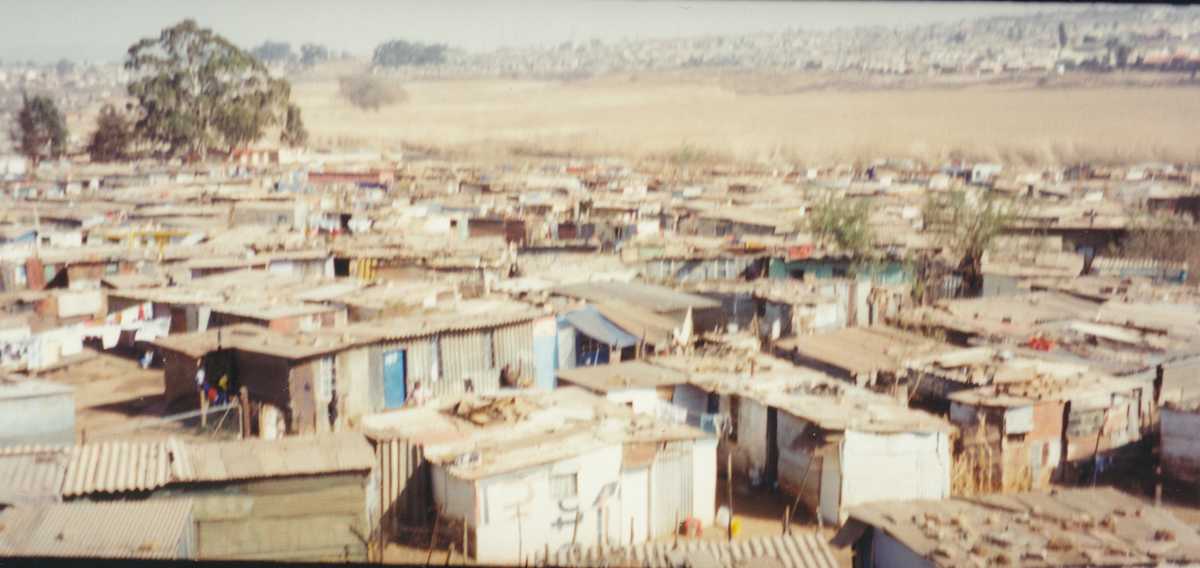
Jack went to South Africa twice on World Bank missions to look at changes in the housing system as apartheid ended. On the first trip, to Jo’berg and Capetown, on the second to Pretoria, the Drakensberg range, Lesotho and Namibia, each of which were responding differently to black rule.
Young black professionals were trained rapidly for management roles. At the Roadside Lodge Bar, Jack watched the numbers of black professionals rise from one man to almost everyone there in four years.
In Drakensberg, Jack met a genuinely racist Boer who had become grudgingly pro-Mandela but was horrified about “miscegenation”. and the thought of his children with "dirty Africans".
Namibia gained independence in 1990, the whites tried to maintain a white enclave in Windhoek, with suitably high indicators of success, while slums built up on the northern outskirts. Jack met Stella Magoye here and asked her to join his team.
In Uganda, Yoweri Museveni ousted the regime of Milton Obote in 1986, but rebel groups continued to fight until 1995. His regime has been variously categorised as illiberal democracy, or as an elected dictatorship. Although authoritarian, he never promoted murder on a wide scale like the regimes of his predecessors. He liked evidence-based policy.
Jack went to Uganda twice, once with his own car. Mr Byaruhanga, the UN-Cities focal point, was the strongest supporter of his programme in Africa. His statistical assistant who collected the indicators was the first person Jack met to die of AIDS
In Tanzania, Julius Nyerere had presided over a benign nonaligned socialist state, but the economy weakened in the 1980s . He retired in 1990, and with the collapse of the Soviet Union, Tanzania began a process of market liberalisation. The country suffered worsening food shortages, decaying educational and health services, unemployment, lack of accommodation, empty shops, and rampant corruption. As is usual, structural adjustment brought galloping inflation somewhat under control. Multiparty democracy was introduced in 1992 and elections were held in 1995. Under Structural Adjustment with the IMF, most parastatals were privatised. The servicing of debt was taking 40% of the budget. Food production did not increase during the 1990s, while the population increased at 3% per year. After 2000, an international program of debt forgiveness supported an inflow of capital, for mineral extraction and export crops. The poverty rate still sits at over 92%, one of the worst levels in Africa., though Kenya is not much better.
The Maasai in Tanzania have particularly suffered under economic policy. At first they were removed from their ancestral lands to make way for large-scale single-crops for export. More recently they have been evicted under a "green agenda" for more wildlife and tourist enclaves, including an exclusive game reserve for the Royal Family of Dubai.
Jack went to Dar es Salaam with Carmen in 1995. He met with the Ardhi Institute, who provided training courses in surveying, design and building economics. He was extremely pleased with the expertise he found there, and two academics were the first to fill in the Indicators form.
In mid 1996, Jack returned as a tourist, travelling across the Serengeti and into the Ngorongoro crater.
Jack and Carmen then proceeded to Zanzibar in severe heat during Ramadan. The first elections were held that year. An economic benefit of the succeeding liberalisation was a thriving tourist industry, mostly Italians and Germans Jack already met on the coast north of Mombasa.
In Ethiopia, the dictator Mengistu fled in 1991 as Soviet support ended, concluding a decades-long civil war. Muslim Eritrea seceded in 1993. The new government allowed a system of ethnic federalism. Jack visited twice and enjoyed Ethiopia’s unique and peculiar culture.
In Somalia, the collapse of central government was followed by brutal clan war and famine as Somalia became a “failed state”. A UN military and humanitarian intervention took place following the withdrawal of the USA, but the UN withdrew in March 1995. An enormous refugee complex of over 300,000 displaced Somalis was established at Dadaab Kenya. about 100 km from the Somali border. Mumbi’s elder sister was a professional aid worker at Dadaab.
It was too dangerous for Jack to go to Somalia, but Greta Gustin had been to the North, where her boss took a bullet in the leg. Jack met Somali former refugees in several small Kenyan towns. They were regarded as dangerous by Kenyans because of concealed weapons and their clannishness.
Eventually, Somali refugees in Nairobi established a vast trade network and today they provide a third of the city’s tax base.
Zambia, formerly Northern Rhodesia, moved to multiparty democracy in 1991 and instituted a heavy program of structural adjustment, which destroyed the economy. Jack found a very effective senior official who organised he collection of his indicators rapidly and professionally. He bought a multiple “emerging heads” ebony statue in a cultural village.
Sudan Colonialism always connected diverse areas and tribes into an artificial unity. In 1946, the British declared two very different zones to be a single country called Sudan– the Arabic-speaking Muslim north and the English-trained Christian South – and in doing so, they set the stage for 50 years of brutal conflict.
At independence in 1956, the South was given little representation and an army mutiny and civil war broke out. The Cold War power blocs supplied arms to the combatants. The Soviets and USA switched sides, with the Soviets supporting the south at first, and then the North. The countries neighbouring Sudan supported different sides in the conflict.
Omar Al-Bashir took power in 1989 and became President in 1993. Under his more militant Islamic regime, Sharia law was instituted, and the war in the south was declared to be a jihad.
Jack was right to be apprehensive during his two 1995 visits to Sudan. The regime was increasingly accused of harbouring extremist Islamist groups. Although Jack was never aware of any of this, Osama bin Laden had been expelled from Saudi Arabia in 1991 and resided in Khartoum until 1996 while he built up his fortune and turned al-Qaeda into a structured organisation. Carlos the Jackal, a Venezuelan who orchestrated terror attacks in France, was captured in Khartoum in August 1994.
South Sudan became independent in 2011. As a result of extended war and deprivation, the country has the world’s lowest nominal per capita GDP per person, andwith Somalia it has the lowest Human Development Index.
Another civil war broke out in 2003, between the Western provinces of (North) Sudan (Darfur) and the Arabised east, commencing with a genocide. As in the previous conflicts, millions were forced into refugee camps, .
Jack travelled to Zimbabwe and Botswana only on holiday. Tourism and travel in southern Africa were still dominated by rich South Africans. In a strong El Niño climatic event, drought was taking its toll, with the Okavango Delta almost dried out.
Zimbabwe had been an “industrial giant” by African standards in 1980, but the country steadily declined, despite mining so many critical materials. Structural adjustment hit Zimbabwe particularly hard. Robert Mugabe took power in Zimbabwe in 1990, thereby ending a long-standing “state of emergency” but creating crises of bad management and impoverishing the country. The economic situation has since been erratic - exports tripled between 1979 and 1997, then fell back to the original level by 2008. Since then the economy has been highly volatile, and hyperinflation has occurred. Zimbabwe has had the greatest rate of expansion of informal settlements of any country.
Nevertheless, the GDP per person is about the same as Kenya, whilethere is almost no poverty. The country trades extensively with South Africa, unlike its neighbours Mozambique, Malawi and Tanzania.
Passing through Harare, Jack was trapped with his family in a poorly-maintained elevator. In his travels in 1996, Jack could not find any accommodation at all in Victoria Falls and had to stay in the back room of an African travel agent who took pity on him.
Kenya
Kenya’s history features throughout Buffalo Gals. The British had a considerably stronger presence in Kenya than in the rest of East Africa, because of the lack of organised resistance, and similar types of apartheid-style exclusion from government and territory. The Mau Mau Rebellion began in 1952, and tens of thousands of Kenyans were held in barbed wire detention camps, while being excluded from Nairobi city. Mumbi’s father acted covertly as Treasure for the revolt. The British began to decolonise Kenya, and finally in 1963, the country became self-governing under the Kikuyu Jomo Kenyatta.
Kenyatta instituted pro-capitalist policies to court the USA, unlike all his neighbours. He maintained stable government with a fairly dictatorial style. He kept the army small in size, to discourage coups. At first, Kenyatta originally bought back land from European farmers and distributed hundreds of thousands of small holdings or shambas to Africans. However, 1.5 million acres of government land near the coast and in the Rift Valley were then transferred to wealthy Kikuyus, causing ongoing racial vilolence.
On Kenyatta’s death in 1978, the Vice President Daniel arap Moi, from a small tribe, the Tugen, was appointed as interim President. He was considered fairly harmless at first, but immediately strengthened Kenyatta’s one-party rule while keeping to the strategic pro-Western course. After the failed 1982 coup (when Mumbi’s classmates were locked in school), he began a programme of selectively eliminating his opponents, without the excesses and wholesale massacres in Uganda, Ethiopia and the Sudan. Kenya was apparently doing well a haven of stability where East African headquarters of many organisations were maintained. But the regime was highly corrupt and quite repressive.
With the demise of Communism, the West was no longer prepared to support dictators and kleptocrats like Moi. Elections were demanded in 1992, and Moi had to repatriate billions of dollars he had concealed abroad. Structural Adjustment, as in other countries, forced a sharp decline in Kenya’s prosperity. Its principal export goods –tourism, tea, and flowers - have not been a strong basis on which to sustain a country.
From 2002, Kenya began to capitalise on its reputation as a regional hub for technology and financial services with a growing entrepreneurial class. Mobile phones had a very rapid takeup, creating new tech-millionaires, bypassing Moi's inadequate fixed line service. Devices are enow assembled in Kenya. Kenya's economy began to improve at a moderate rate.